
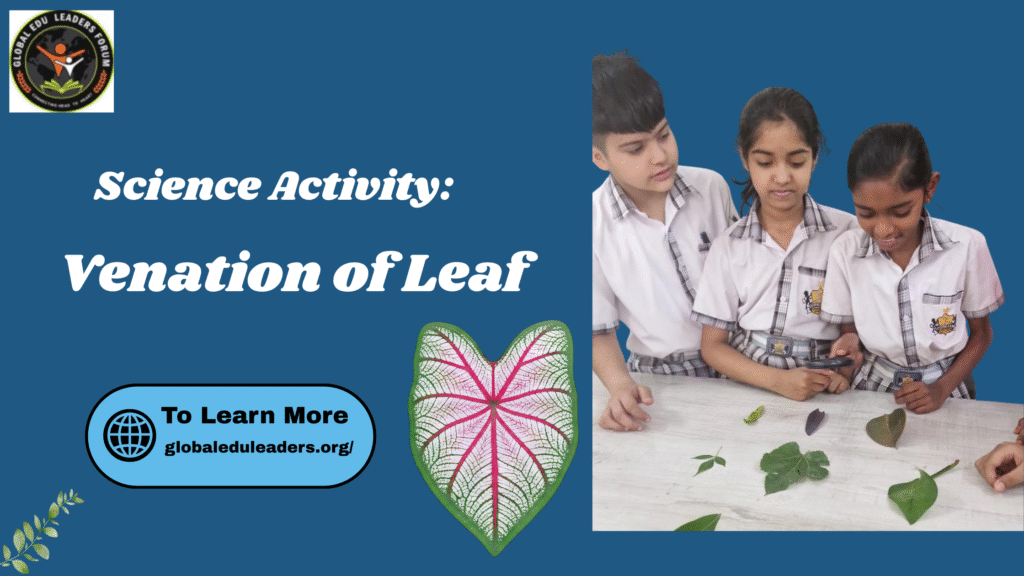
Are you aware of the time when you looked at a leaf and noticed thin lines running across the leaf? These lines are referred to as veins. The arrangement of them is called the venation of leaf.
In this blog from Global Edu Leaders Forum, we will discover the meaning of leaf venation, its types, and how to use it, as well as examples. It is an enjoyable activity that you can play at home or at school. We’ll keep it very simple so that even 5th-grade students will be able to grasp the concepts easily.
🌿 What is Venation of Leaf?
Venation of leaf refers to the pattern of veins that are present on the leaf.
In simple terms:
It is how the lines (veins) are laid out on the leaf.
The leaf’s veins aid in numerous ways:
- Take water and other nutrients with you.
- Help the leaf
- Assistance in the transportation of food
🤔 Why is Venation Important?
You may be wondering why we should be aware of this.
Here’s the reason why the venation of leaf is crucial:
- It aids plants to stay strong.
- It assists in transporting water and food
- It allows us to identify various plants.
- It is an essential idea in science examinations.
Yes, it’s tiny, but it is very vital!
🌱 Types of Leaf Venation
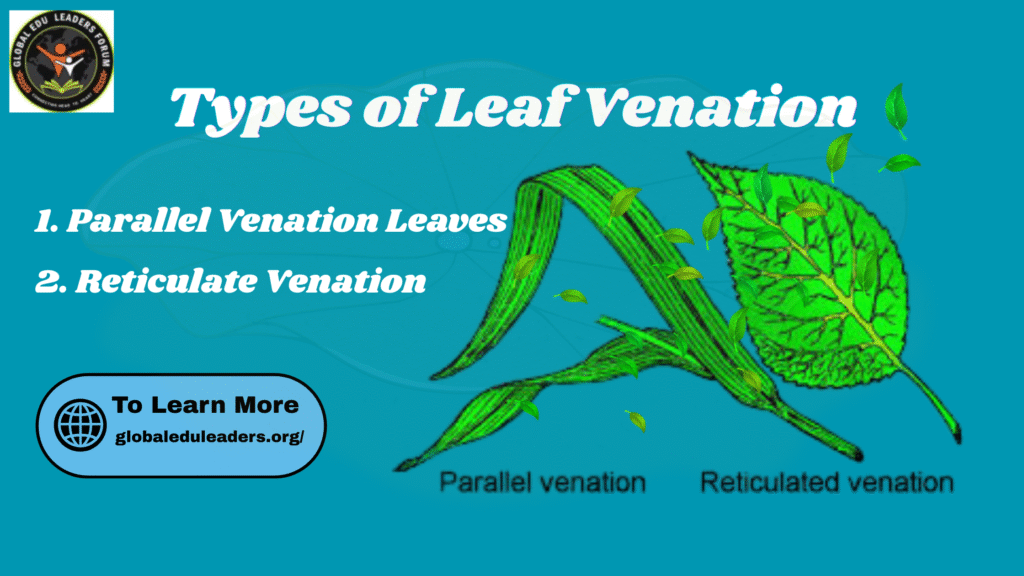
There are generally Two types of leaf venation that you must be aware of.
Let’s look at them one by one in an easy manner.
1. Parallel Venation Leaves
In this form of veins, they run parallel to one another from the base up to the top on the leaf.
Meaning:
All lines are in the same direction and do not cross one another.
Examples of Parallel Venation Leaves:
- Grass
- Banana leaf
- Wheat
When you look at the banana leaf, it is easy to see straight lines that run parallel to each other.
2. Reticulate Venation
In this form the veins create an e-net (like an internet).
Meaning:
The lines are connected and extend like the web.
Examples:
- Mango leaf
- Neem leaf
- Rose leaf
The leaves look like they have the appearance of mesh.
📚 Types of Leaf Venation with Examples (Quick Table)
| Type of Venation | Pattern | Examples |
| Parallel Venation | Parallel and straight lines | Banana, Grass, Wheat |
| Reticulate Venation | Net-like pattern | Mango, Neem, Rose |
🔍 How to Identify Venation of Leaf?
You don’t have to worry, it’s very simple!
Follow these easy steps:
- Use any leaf
- Pay attention to the veins
- Do you ask yourself:
- Are the lines parallel and straight? Parallel venation
- Are the lines making up the net forming Reticulate venation
That’s it! You’ve learned to recognize different types of leaf Venation.
🧠 What is the Difference Between the Two Types?
It’s not necessary to be concerned; it’s easy!
Follow these simple steps:
- Make use of any leaf
- Pay close attention to the veins
- Do you ask yourself:
- Does the line appear straight and parallel? Parallel venation
- is the lines that make up the net Reticulate Venation
It’s done! You’ve learned to distinguish different kinds of Leaf Venation.
🎯 Benefits of Learning Leaf Venation
Knowing about the venation of leaves is beneficial in many ways:
- Helps students with school tests
- Enhances the ability to observe
- Fun and practical, it makes science enjoyable.
- Helps you identify the plants you see around you.
- Develops the foundational knowledge needed for higher levels of education.
🧪 Simple Activity for Students (Fun Learning!)
Let’s have a blast doing a game to learn more about leaf venation.
Activity: Leaf Rubbing Art
What You Need:
- A leaf
- Paper
- Pencil or crayon
Steps:
- Place the leaf on top of the paper
- The crayon is gently rubbed on the paper
- The blood vessels appear on the paper.
Then, observe:
- Is the line straight?
- Are they building networks?
Congratulations! You’ve explored the different kinds of leaf venation, including examples in a fun and engaging way.
🌍 How is This Useful in Real Life?
It’s possible to think that this is just for exam preparation. However, it’s very useful in everyday life as well.
- Farmers can easily identify plants
- Scientists research plant species
- Gardeners tend to take better care of plants
- Students learn to appreciate nature more
🏫 Real-Life Examples Around You
If you’re planning to go out Try this:
- Look at grass – Parallel venation
- Take a look at the mango leaf. Reticulate the venation
Learning can be enjoyable when you are able to observe the beauty of nature!
⭐ Tips to Remember Easily
- Banana = Parallel
- Mango = Reticulate
- Straight lines = Parallel
- Net pattern = Reticulate
Try this trick for your exams!
🧾 Final Thoughts
Understanding the venation of leaf is a breeze when you master the process step-by-step. There are two kinds of leaf venation, parallel and reticulate. Each one has its own distinct pattern and examples.
With a simple observation and fun activities, you will be able to discern different kinds of leaves that surround you.
We at the Global Edu Leaders Forum believe that learning should be enjoyable, simple,y and useful. If you happen to see the leaf, don’t look away, but observe it like an aspiring scientist!
💬 Student Testimonials
“Learning Made Easy!”
“I had no idea what leaf venation was prior to this and this explanation has made the process easy!”
— Riya, Class 5
“Fun Activity Helped Me!”
“The leaf rubbing exercise was fantastic. I learned a lot while playing!”
— Aarav, Class 6
🚀 Final Tip
If you’re looking to get top marks in science, you must
- Learn about concepts using simple language
- Learn from real-life examples
- Do fun activities
Friendly Quick Answers
❓ What is venation of leaf?
Veination of leaf is an arrangement of veins that appears on leaves. It shows how lines are distributed across the leaf’s surface.
❓ What are the types of leaf venation?
There are two major kinds of leaf venation: parallel venation and reticulate venation.
❓ What are parallel venation leaves?
Parallel venation leaves are characterized by veins that run in straight lines that are parallel from the base up to the tip, similar to grass and banana leaves.
❓ How can we identify leaf venation?
It is possible to determine leaf venation by observing the patterns of veins. Straight lines are a sign of parallel venation. A net pattern is a reticulate venation.
❓ Why is leaf venation important?
Leaf venation is essential as it assists in the transport of nutrients and water, as well as providing assistance to the leaf.